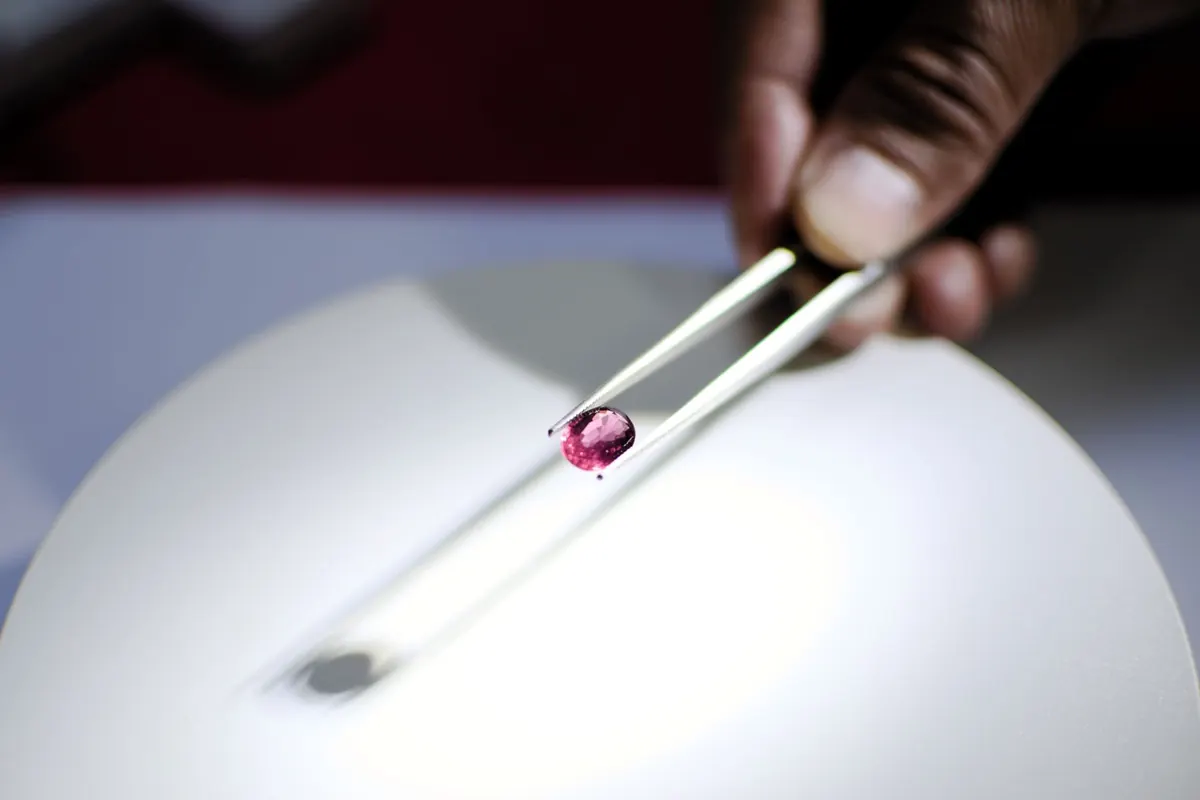
Hold an amethyst crystal up to a lamp and you may see more than purple. There is often a white tip, a faint chevron of deeper violet, a band running parallel to one of the crystal's flat faces. Nothing stained the stone. Those bands were built in, layer by layer, while the crystal grew in a cavity or a vein, and they are among the most honest records a gemstone carries. Learn to read color zoning and you gain a working tool: a way to judge cutting decisions, to question treatments, and to understand why two stones of the same species can look nothing alike.
Color zoning is an uneven distribution of color inside a single crystal. The cause is usually an uneven distribution of whatever produces the color in the first place: iron and titanium in sapphire, chromium in ruby and emerald, manganese in spessartine garnet. Sometimes color comes from structural defects rather than impurities — the color centres in amethyst and smoky quartz are the classic case — and those can be distributed just as unevenly as any trace element.
Three things get confused with zoning, and it helps to separate them. Pleochroism is a change of color with viewing direction, present in tanzanite, kunzite and iolite; the stone looks different from different angles but is chemically uniform. Parti-coloration is simply a strong, coarse version of zoning, where two distinct colours occupy large portions of the stone. Inclusions are foreign material — a rutile needle, a fluid veil — whereas zoning belongs to the host crystal's own structure. A zoned stone is not a flawed stone. It is a stone with a history.
A crystal grows by taking atoms out of the fluid or melt around it. The growing face consumes the colouring ions faster than the surrounding fluid can resupply them, so the thin layer of liquid or melt touching the crystal becomes depleted. The crystal then lays down paler material until the supply catches up. That alone produces fine rhythmic banding, often too subtle to see without magnification.
Larger events leave stronger marks. A drop in temperature, a fresh pulse of mineral-rich fluid, a change in pressure, or a shift in how oxygen-rich the environment is can switch the color on or off. In sapphire, the same iron can contribute to blue in one zone and to yellow or green in another, depending on the oxidation state of the fluid and how titanium is taken up. When the change is abrupt, the boundary between bands is sharp; when the fluid drifts slowly, the transition is gradual and the stone looks softly graded.
Growth also stops. Crystals get interrupted by earthquakes, by cavities sealing, by competition from neighbouring crystals. Restart after a pause often leaves a visible boundary, and sometimes a phantom: a small crystal outline frozen inside the larger one. Twinning can create hard colour boundaries too, because the two halves of a twinned crystal do not accept impurities identically.
Two patterns matter most in the trade. Growth zoning produces bands that follow the shape of the crystal faces — straight, parallel lines in sapphire and ruby, chevrons in amethyst, concentric shells in tourmaline. Because the bands follow the outside shape of the crystal, they are your best clue to which direction the rough once faced.
Sector zoning is different. Different faces of the same crystal, growing side by side at the same moment, incorporate impurities at different rates. The result, seen in a cut stone, is a pie-slice pattern radiating from the centre rather than parallel layers. Sapphire, diamond and titanite can all show it. Sector zoning tells you about the crystal's geometry, not its calendar.
A cutter reads zoning before the first saw cut. If the bands run parallel to the intended table, the stone faces up as a single even colour; if the table is cut across the bands, the stone shows stripes. That is the whole trick, and it explains two things buyers often find puzzling.
First, a beautifully coloured rough can produce a disappointing stone if the zoning is ignored — pale stripes across a saturated blue sapphire are usually a cutting decision, not a defect of the material. Second, zoning can be used deliberately. Setting the culet in the deepest colour zone lets the pavilion facets bounce that colour back through the crown, lifting a stone that would otherwise look washed out. Some cutters go the other way on purpose, orienting parti-coloured rough so the split shows across the face, because a well-balanced half-and-half stone is a feature, not a fault.
Zoned stones are usually priced below evenly coloured stones of the same size and clarity, though patterned material such as watermelon tourmaline and good ametrine is sold as a premium feature. Ask directly whether the colour is zoned — a straightforward dealer will tell you, and will show you the stone face-down if you ask.
Think about the setting before you commit. Open-back settings let light through the pavilion and show zoning honestly; a closed bezel hides it, sometimes flattering a stone and sometimes making it look muddy. Judge the stone in the kind of light where it will actually be worn — a jeweller's warm spotlights can make a pale rim disappear and bring out a brownish zone you did not notice.
For anything of real value, treat your own observations as a first pass rather than a verdict. Zoning supports what a gemologist sees, but it does not by itself prove origin or rule out treatment, and a laboratory report is the sensible next step.
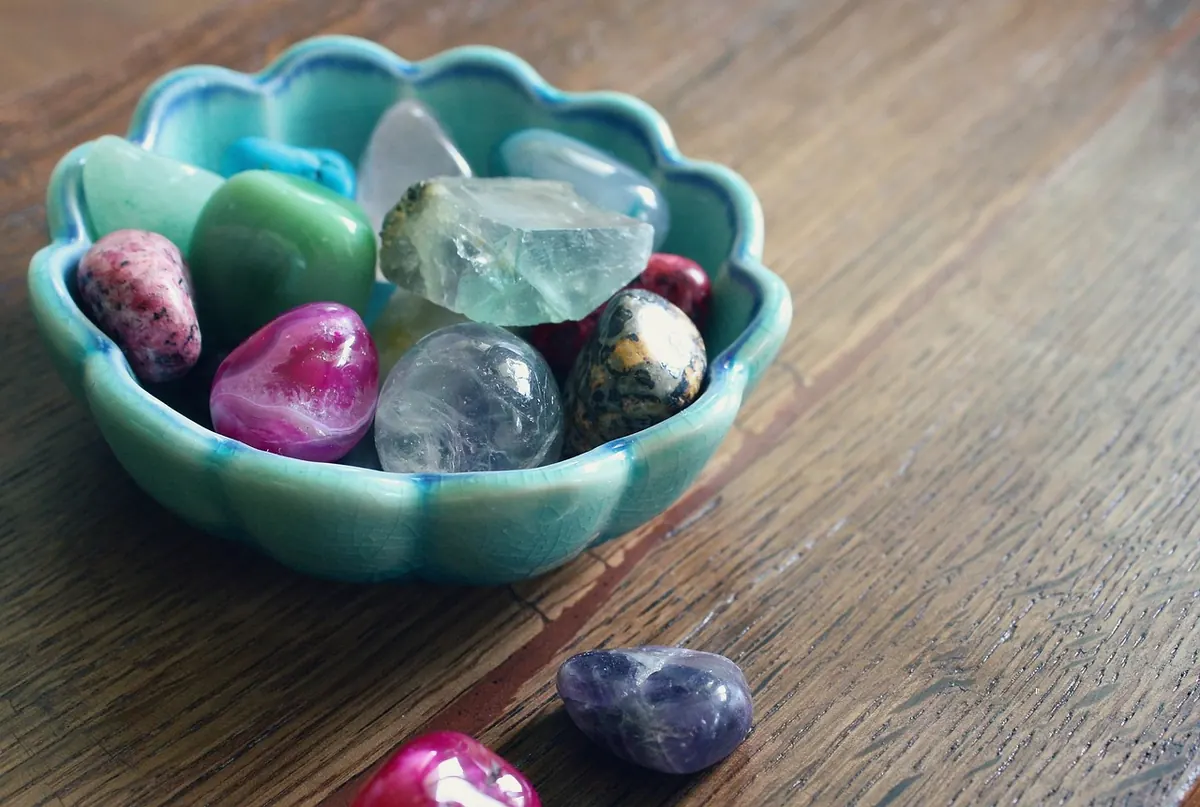
Photo: ponce_photography / Pixabay